Durian · Paddy · Vegetables
Your trees have been telling you for years.
Moss on the trunk is a reading, not a nuisance. Here is how to take it, and what it means.
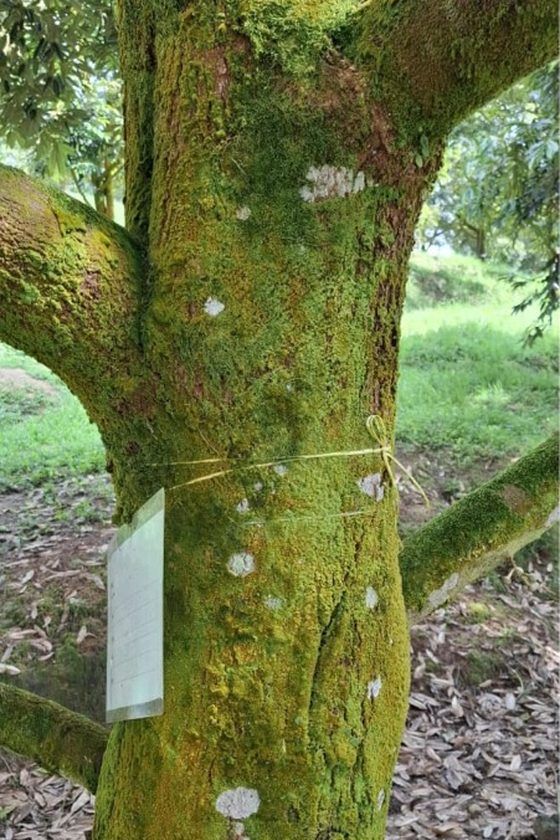
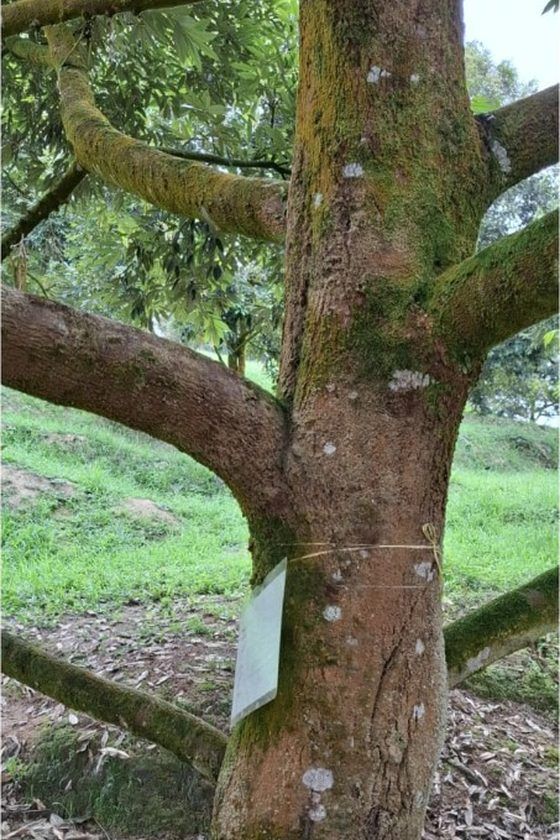
Five things to check on your own trees this week
None of this needs us, a laboratory or a purchase. Walk your worst block and look for these. If four of the five are familiar, you already know what your soil is doing.
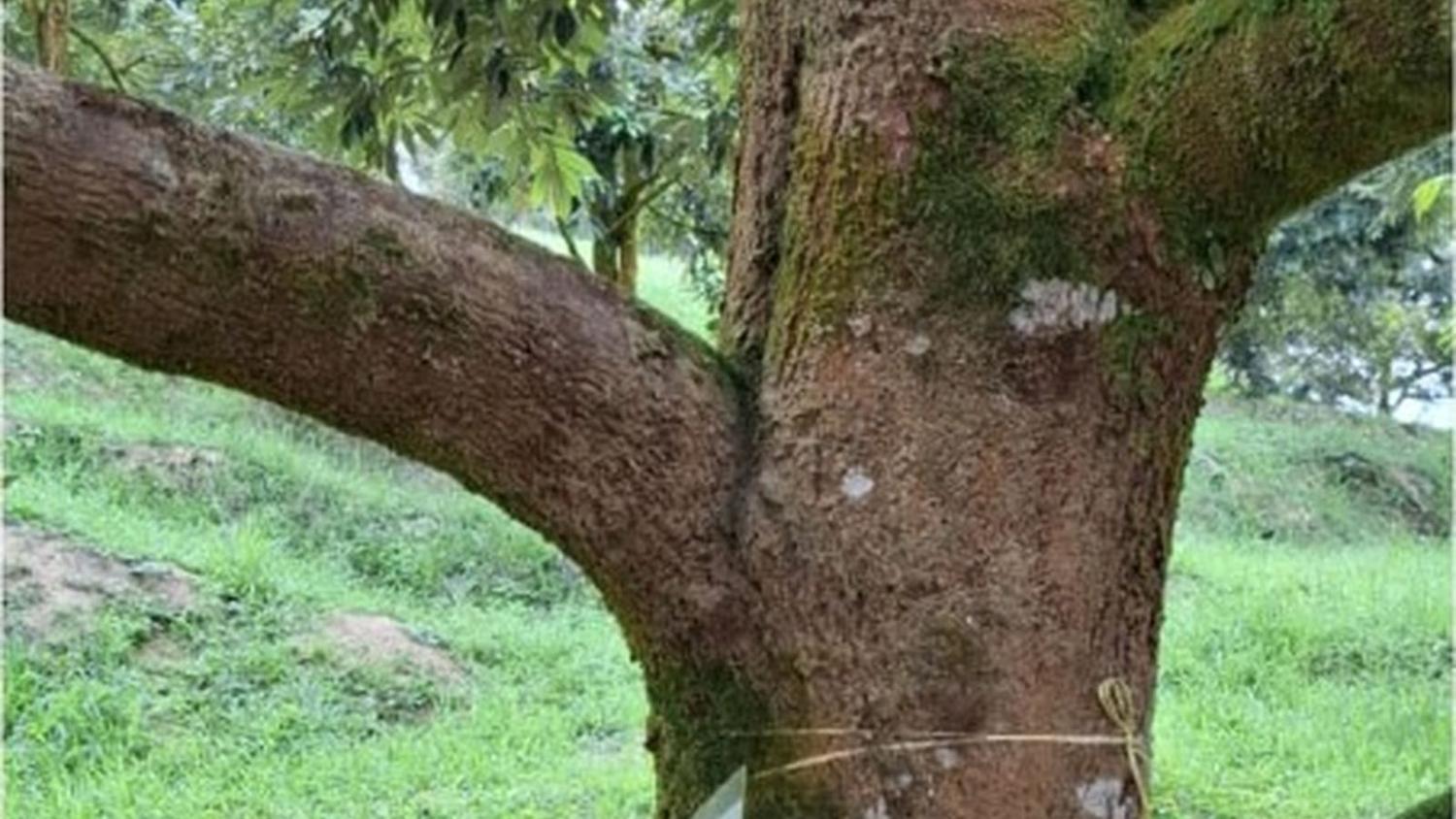
Moss and algae coating the trunk
Bark that stays permanently damp because the tree is not moving moisture the way a healthy one does. Scraping it off treats the appearance.
Poor air movement at the trunk and a tree working below capacity. Read it alongside sign 02.
Soft, sappy new flush that pests find first
Lush-looking growth that psyllids, scale and green hoppers reach before you do. It looks like vigour and is actually weak tissue.
Nitrogen going in faster than the tree can process it. The flush is soft because the cell walls formed poorly.
Lesions and weeping at the trunk or root collar
Canker. Usually treated as a fungal problem with fungicide, which addresses the half of it you can see.
Bark low in resin and phenolics has stopped being armour. The fungus is an opportunist, not the origin.
Water sitting after rain, or ground you cannot push a rod into
Compaction and poor drainage. Easy to check and the one farmers most often skip.
Low oxygen in the root zone. Nitrification stalls, ammonium accumulates and roots cannot respire properly.
The same spray, working for less time each season
Shorter intervals between rounds, or more rounds for the same result, at the same rate.
You are treating the symptom on a schedule while the condition producing it continues underneath.
Every one of these is a soil reading taken from above ground. That is why the assessment starts at the trunk and the root collar rather than with a product catalogue.
Farmers here already had a word for it. Baja panas.
The instinct that hot fertilizer burns the tree predates anyone measuring it, and it is correct. What follows is what is actually happening when it runs hot.
The chain that ends at your sprayer
Heavy nitrogen goes onto ground with little oxygen. Nitrification stalls, so ammonium concentrates around the roots instead of converting into the nitrate the tree can use. In a hot dry spell it concentrates further and part of it comes off as ammonia gas, which burns roots and damages what is left of the soil life.
The tree then absorbs it faster than it has energy to process. Carbon becomes the limiting factor. Cell walls form weak, calcium structure is poor, membranes lose integrity, and antioxidant capacity gets spent faster than it is replaced.
Now every sign on the list above makes sense at once. Soft flush, because the tissue formed badly. Pests on that flush, because soft nitrogen-rich tissue is preferred feed. Canker at the trunk, because bark low in resin cannot hold a boundary. Moss on the bark, because the tree is not functioning.
Spray removes the generation that arrived. It does not touch the reason they came. Which is why the interval shortens each season and the bill grows while the trees do not.
The real question is whether it costs you yield
One ginger field in Banting, one photograph. The furrow down the middle is the boundary. The farmer worked both halves the same way except for one thing.
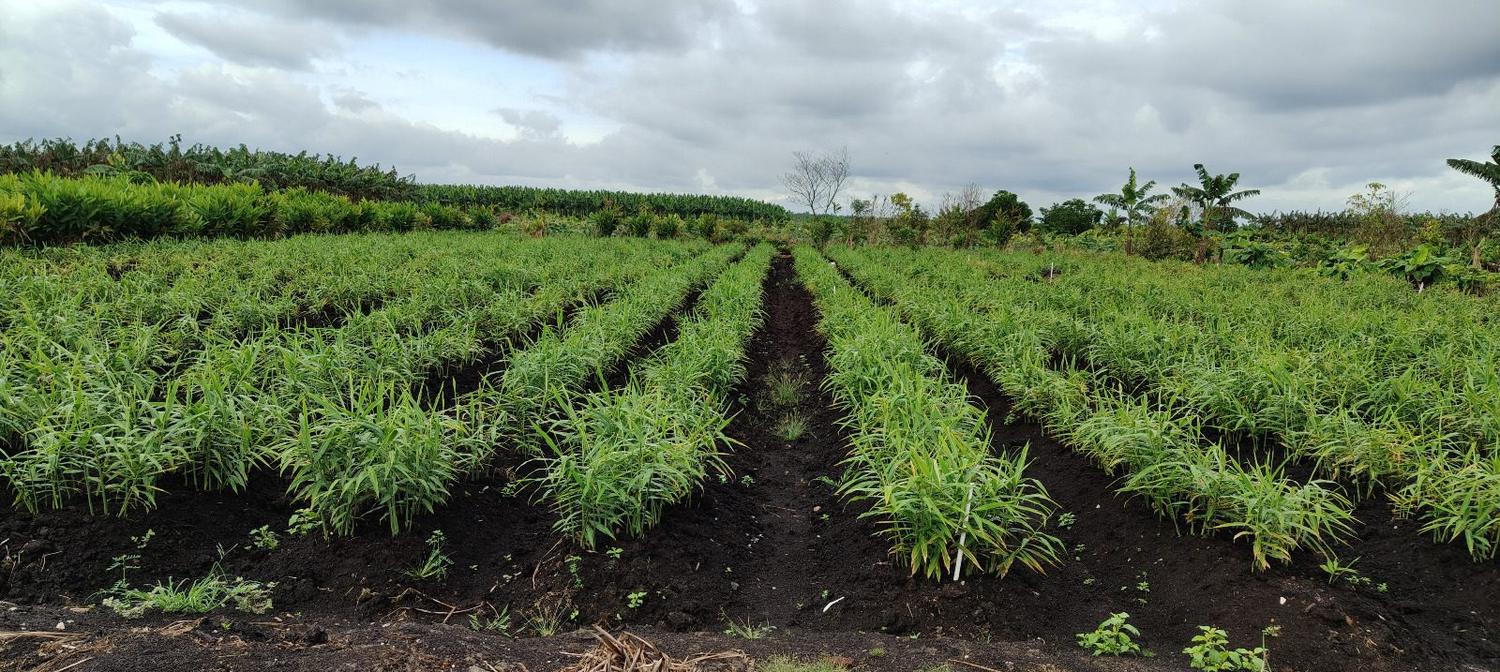 Left of the line
With pesticide Right of the line
No pesticide
The farmer's normal practice, using his usual pesticide programme on his usual schedule.
The Morandro system, no pesticide. The white marker stick stands in this block. Same field, same soil, same weather, same hands, same day.
Nothing dramatic is happening in this photograph, and that is the entire point. Both blocks are carrying the same crop. When someone tells you pesticide-free costs you yield, this is the picture worth asking them for.
Four durian recoveries, each with the dates attached
Drag each comparison. Every frame carries the date it was taken, and the interval is simply the arithmetic between them.
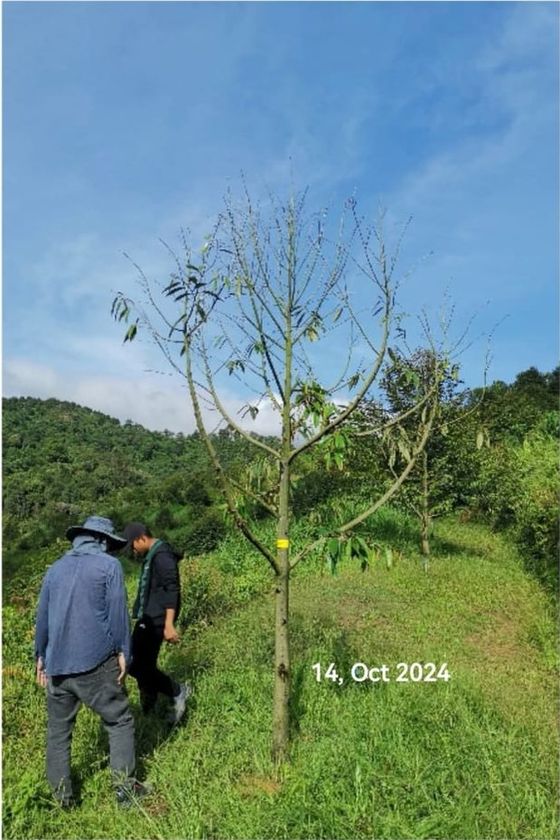
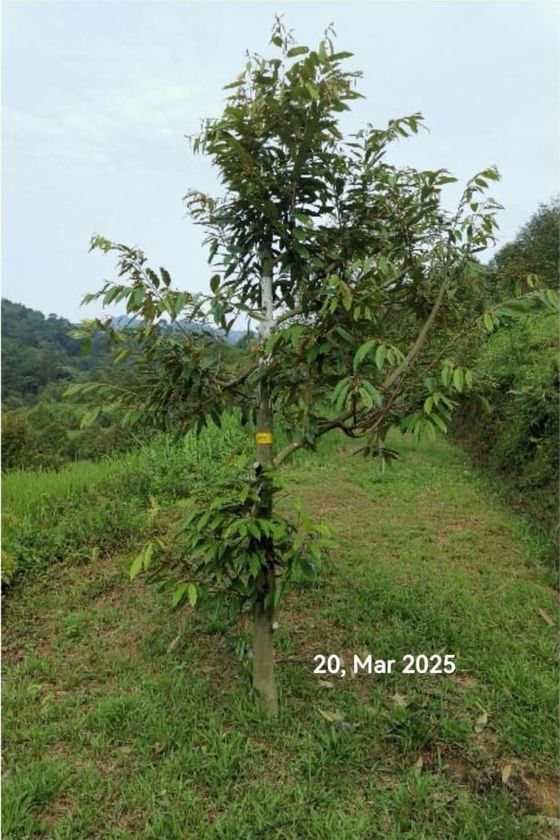
Near total leaf loss with dieback through the branch tips. A tree at this stage is normally cut and replanted. Identified by the yellow trunk tag in both frames.
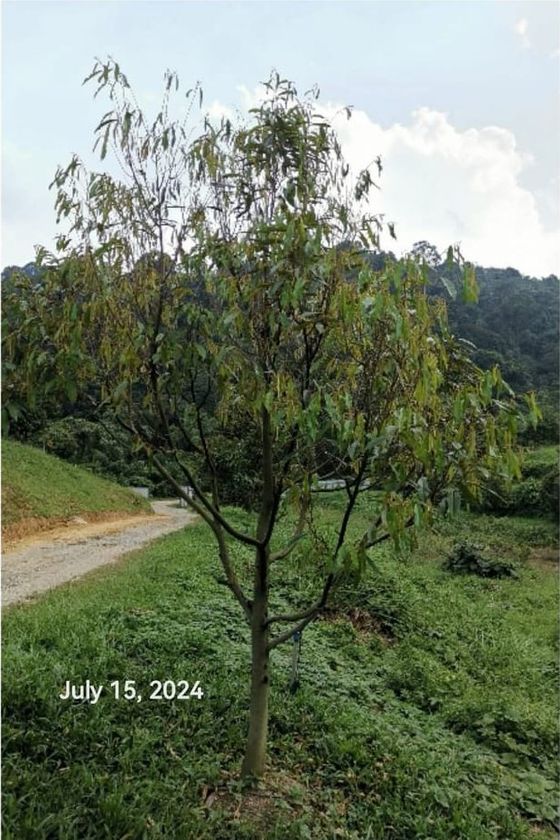
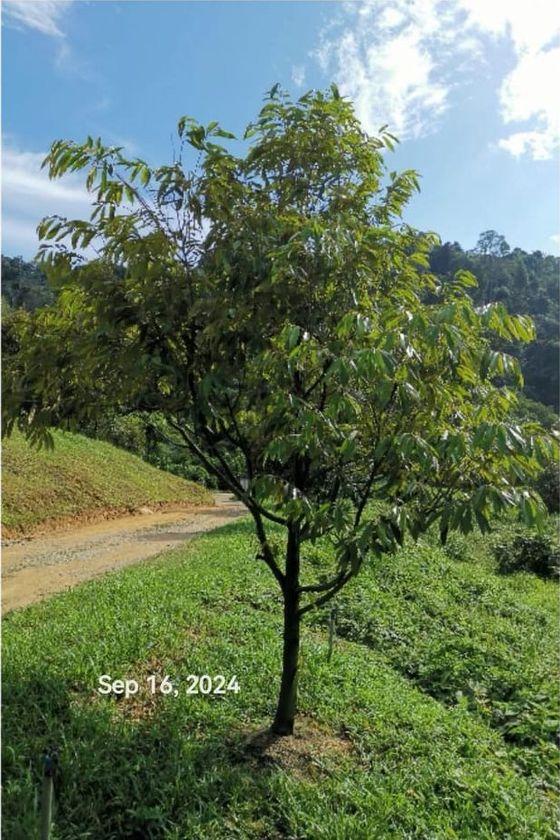
Thin, yellowing canopy holding very little leaf. Same tree, same track and same bank behind it in both frames.
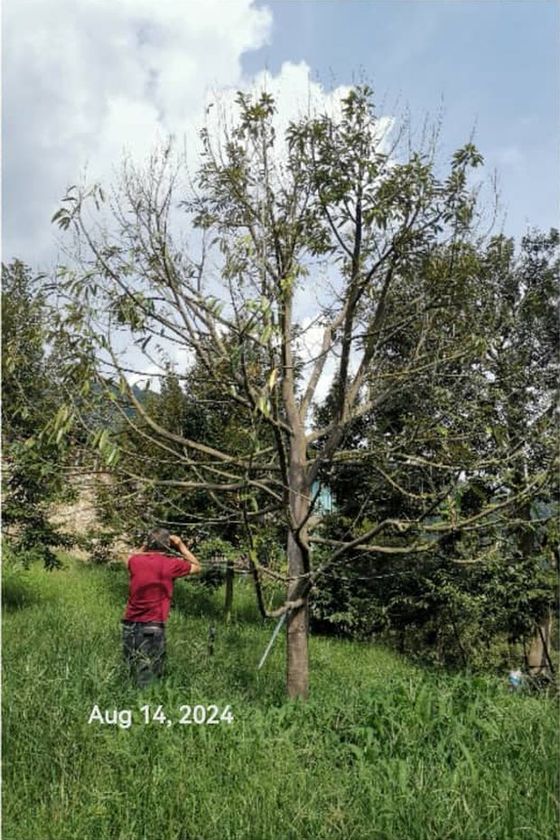
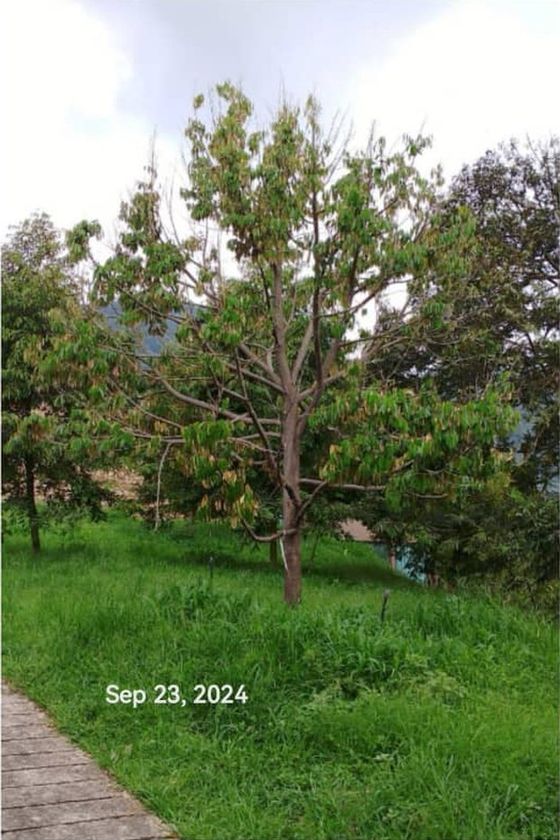
A larger, older tree carrying mostly bare scaffold branches. Recovery on a mature tree shows first as leaf density rather than height.
These are four trees on farms we work with, not an average across a population. Trees further into decline do not always come back, and the assessment will tell you plainly which of yours are worth treating and which are worth replacing.
The fourth one is a single lesion, photographed four times
Trunk canker on one tree, opened up and then left to close on its own as the tree recovered. No fungicide was applied to it.
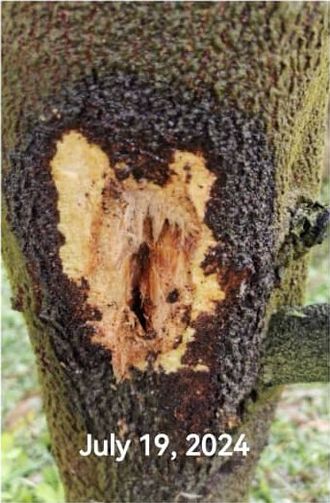
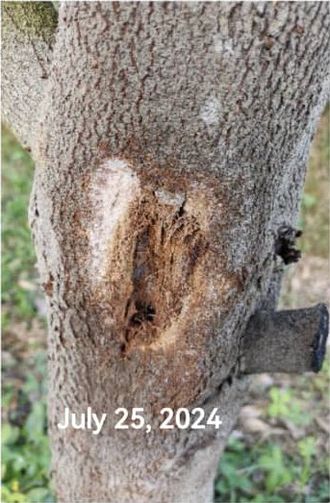
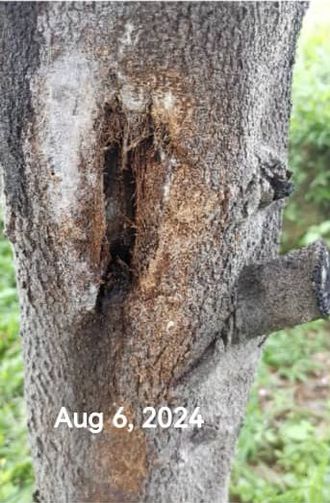
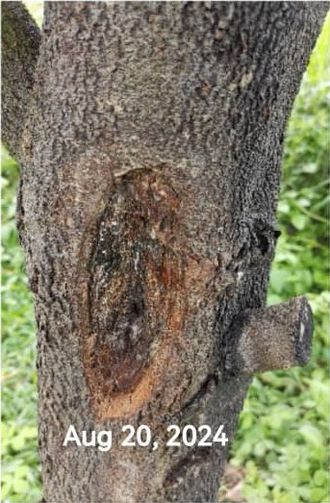
A tree only closes a wound like that when it has the energy and the calcium to build the tissue. That is the whole argument on this page, at the scale of one lesion.
The sign that the ground itself has restarted
These two frames are not a before and after. They are a wide shot and a close-up of the same spot, taken because of what had appeared at the base of the tree.
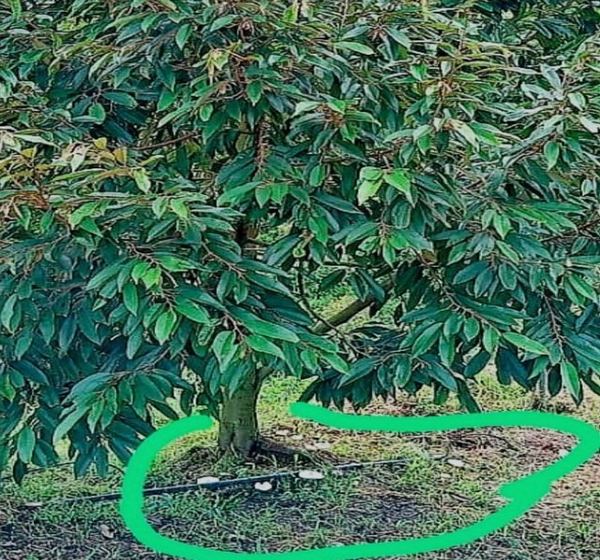
Circled on the day, because of what had started growing at the root collar.
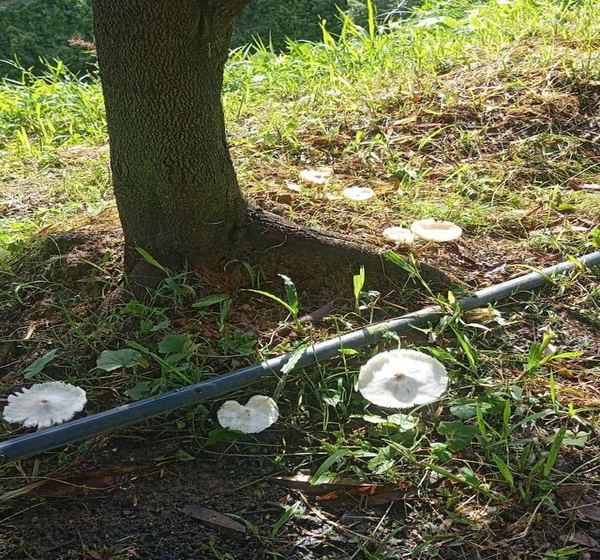
They break organic matter down and hand nutrients back to the roots. They do not appear in ground sterilised by years of chemical load.
Mushrooms at the collar worry some farmers, because the assumption is that any fungus is a pathogen. Saprophytes are the opposite. They are the recycling crew, and their return is one of the earliest signs the soil is working again.
Farmers who learned to read it themselves
“They taught me soil chemistry and plant cycles. Once I understood that, the results came.”
“I was over-relying on chemical fertilizer. Yields are up and my durians are consistently better.”
“Pest pressure is down and our plants grow stronger with less intervention.”

On the record
With Datuk Chan Foong Hin, Deputy Minister of Agriculture and Food Security. Reducing pesticide use is on the national agenda, and we are glad to be working on it.
Start by telling us what keeps coming back
Thirty minutes on the phone to work out what is actually happening on your farm. No products, no quote, and nothing applied to your land.
What we will ask you
- Which blocks are strugglingHow long it has been going on, and whether it is spreading or holding in one place.
- What you are feedingWhich fertilizer, how much per tree or per acre, and on what schedule.
- What you spray, and how oftenAnd how quickly the same problem comes back after each round.
- What the ground does after heavy rainWhether water sits on it, and whether you can push a rod into it.
- What an acre costs you nowFertilizer, spray, labour and fuel, so there is something real to compare against later.
No products on the first call. We are working out what is actually happening on your land, and whether we are the right people to help at all.
Book your call
Free and no obligation, Peninsular Malaysia. We will tell you if you are outside our range.
Straight answers
If you are telling me how to diagnose it, what am I paying for?
Reading the signs is the easy half and we are happy to give it away. The paid half is sequencing the correction for your soil, sourcing inputs formulated for it, and holding the programme through the transition. Getting the order wrong wastes most of the input.
Are those really the same trees in the comparisons?
Yes. Each pair matches on trunk tag, ground slope, track and the tree line behind, and every frame carries the date it was taken. We will send you the full sequences, including the frames in between, after the call.
Why is the ginger field only one photograph?
Because a single frame containing both blocks is stronger than two frames taken at different moments. Nothing can be swapped, staged or shot on a better day. You are looking at both treatments in the same field under identical light.
Will every declining tree recover like these?
No, and we will not pretend otherwise. Some trees are too far gone and come out regardless. The four here took between 32 and 157 days, which is a range, not a promise. The assessment tells you which of your trees are worth treating.
Will my yield drop while I change over?
The stages overlap deliberately. Soil and nutrition are corrected before protection is reduced, so tissue is already harder before it is less defended. That is also why any change starts on a small block rather than across your whole season.
Is this more expensive than what I use now?
Cost per acre usually moves rather than rises, because fertilizer volume and spray rounds both come down while system inputs go up. We build that comparison from your own invoices before you commit.
Can I still use chemicals if I need to?
Yes. This is not a purity test. Many farms run a hybrid for a season or two and keep a chemical option for emergencies. The goal is that the plant stops needing it.
Does this make my produce certified organic?
No. Certification is a separate audited process with its own requirements. The system is applied without regulated toxic pesticides, which describes what we put on your crop, not a certification of what you sell.